
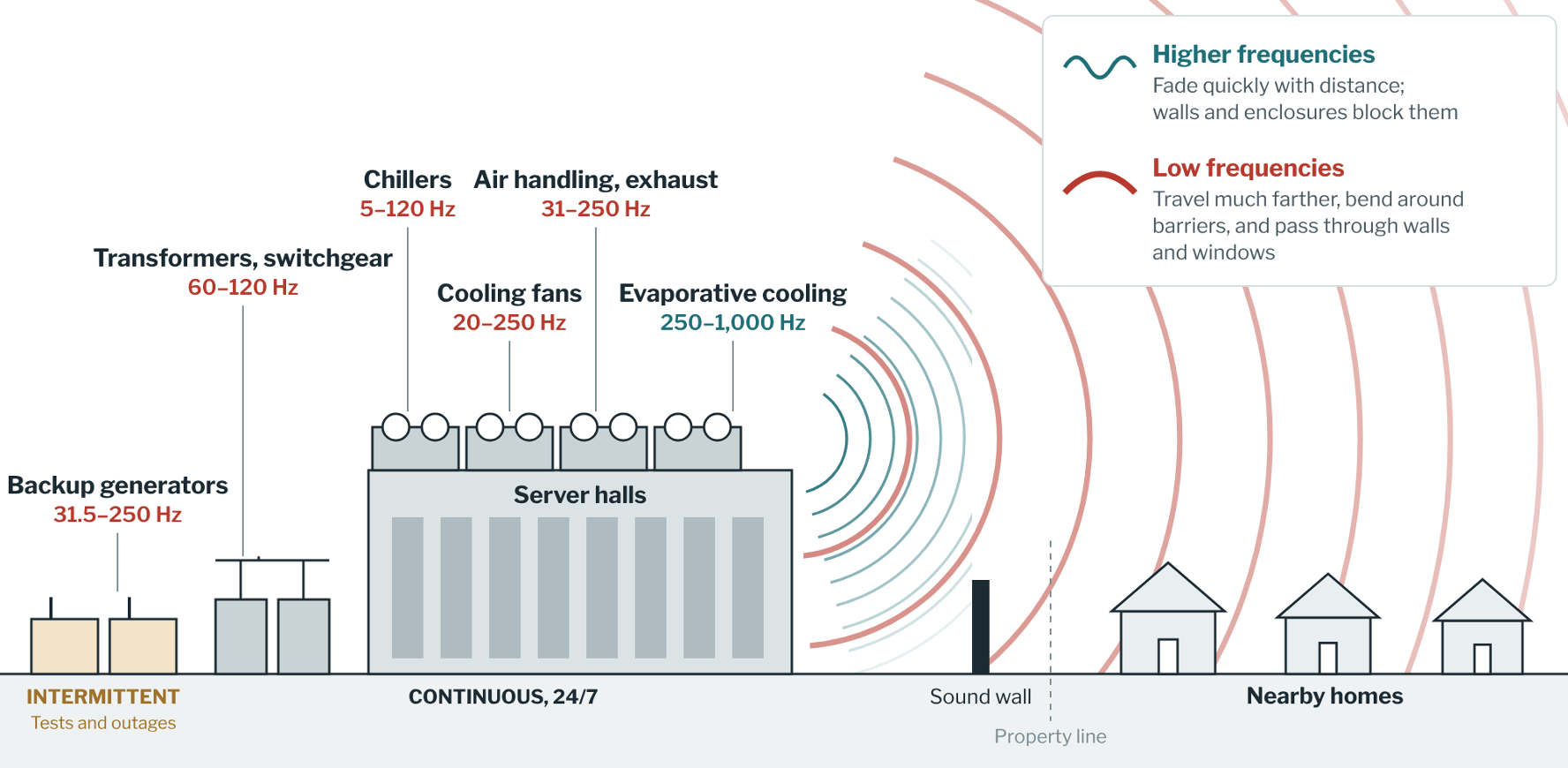
Data center noise is different
data center noise is different than standard industrial noise and most regulations fail to capture or measure it properly
Data centers run around the clock, and much of their sound sits at low frequencies that travel long distances, pass through walls and windows, and are largely missed by the A-weighted (dBA) measurements most noise regulations rely on. This page explains what actually makes the noise in data centers, why it behaves differently from other industrial noise, and how to shape noise regulations to appropriately protect the community.
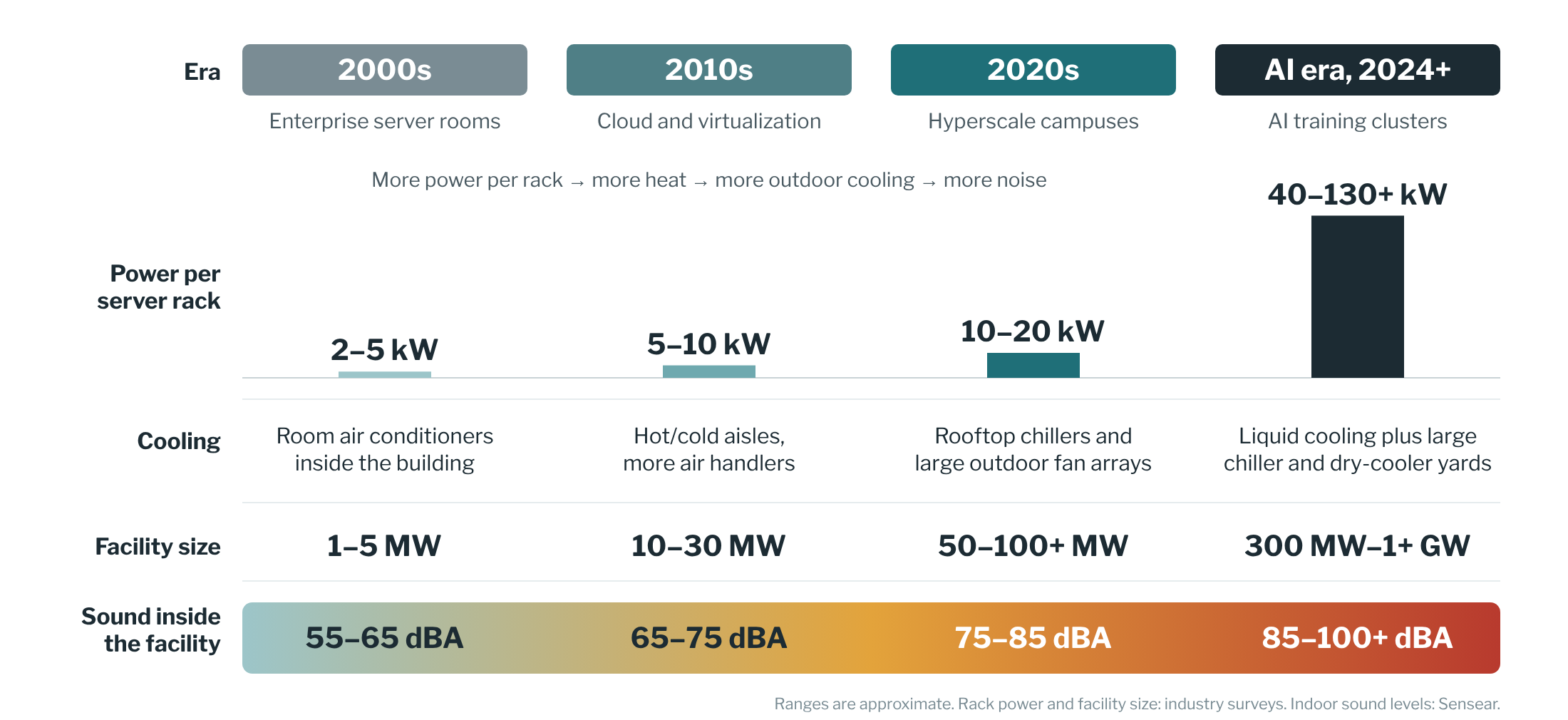
Data centers are getting louder
The computers inside AI data centers draw far more power than earlier servers [1-2]. Nearly all of that power becomes heat, and removing that heat takes more and larger cooling equipment. In addition, facilities have grown from a few megawatts to campuses of hundreds of megawatts or more.
What produces noise at data centers?
Most equipment at data centers runs 24/7, 365 days a year to provide constant cooling to protect the chips that provide the majority of computing power. Cooling fans, chillers, air handlers and transformers run continuously during the day and night. Most of their sound energy falls between about 20 and 250 Hz. Backup generators add loud intermittent noise during regularly-scheduled load tests and power outages. Construction and service traffic add more.
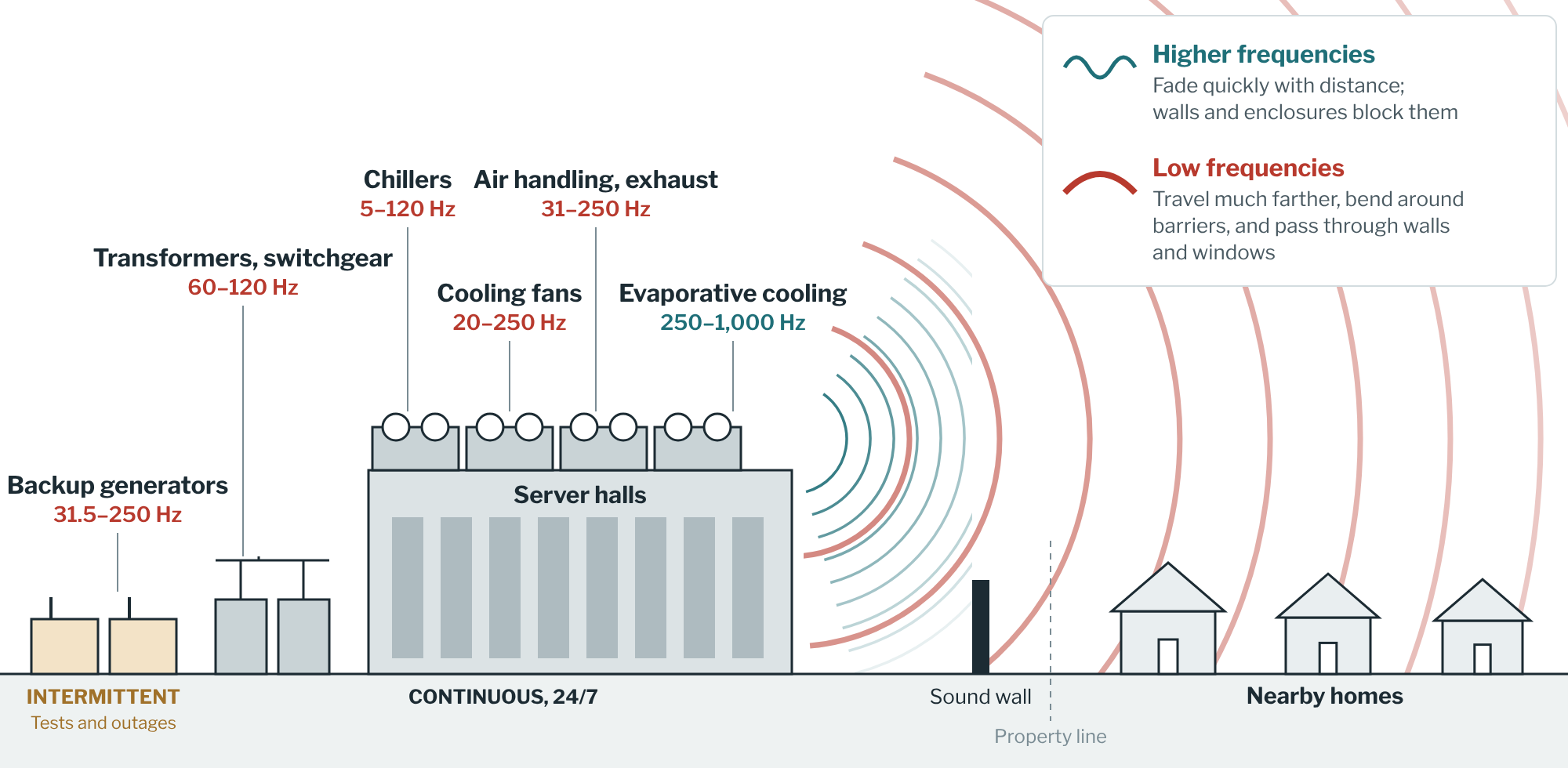
Sources of continuous noise: Cooling fans (20-250 Hz), large chillers (5-120 Hz), air handling and exhaust (31-250 Hz), transformers (120 Hz hum) and switchgear (60-120 Hz vibration, intermittent clangs), Evaporative cooling (250-1,000+ Hz). Intermittent noise: backup generators, local construction and service traffic.
Why REDUCING the noise is challenge for low frequencies
A lot of data noise sits in lower frequencies that are not easily blocked by standard mitigation strategies. Acoustic enclosures and exterior barriers are limited in their effectiveness against the low frequency noise produced by data centers for multiple reasons reasons:
Low frequencies have long wavelengths that do not lose as much energy as they travel away from the source. Air itself actually dampens sound as it travels, but air absorbs only ~0.1 dB per kilometer at 63 Hz compared with ~16 dB per kilometer at 2,000 Hz [3].
Low frequencies bend around barriers. Sound walls are effective only against sounds with wavelengths that are short compared with the wall. But, at 63 Hz, a wavelength is about 18 feet and can bend around structures.
Absorbing material has to be very thick. Porous sound-absorbing material works well only when it is about a quarter of a wavelength thick: roughly 4.5 feet at 63 Hz and 14 feet at 20 Hz…versus a couple of inches for 2,000 Hz.
Low-frequency noise can be reduced, but mainly through long distances, very heavy enclosures, quieter equipment, or equipment placement underground.
It is often far more expensive to reduce low frequency noise versus higher frequency noise.
Noise regulations written for standard industrial installations do not translate well to data centers
Problem 1: dBA measurements underweight low frequencies
Most noise ordinances set limits in dBA. This A-weighting adjusts a sound meter reading to approximate the sensitivity of human hearing to quiet sound, so it undercounts low frequencies. At 125 Hz, a dBA reading counts 2.4% of the sound energy; at 63 Hz, it counts 0.24%. C-weighting (dBC) counts low frequencies more closely to the actual sound produced.
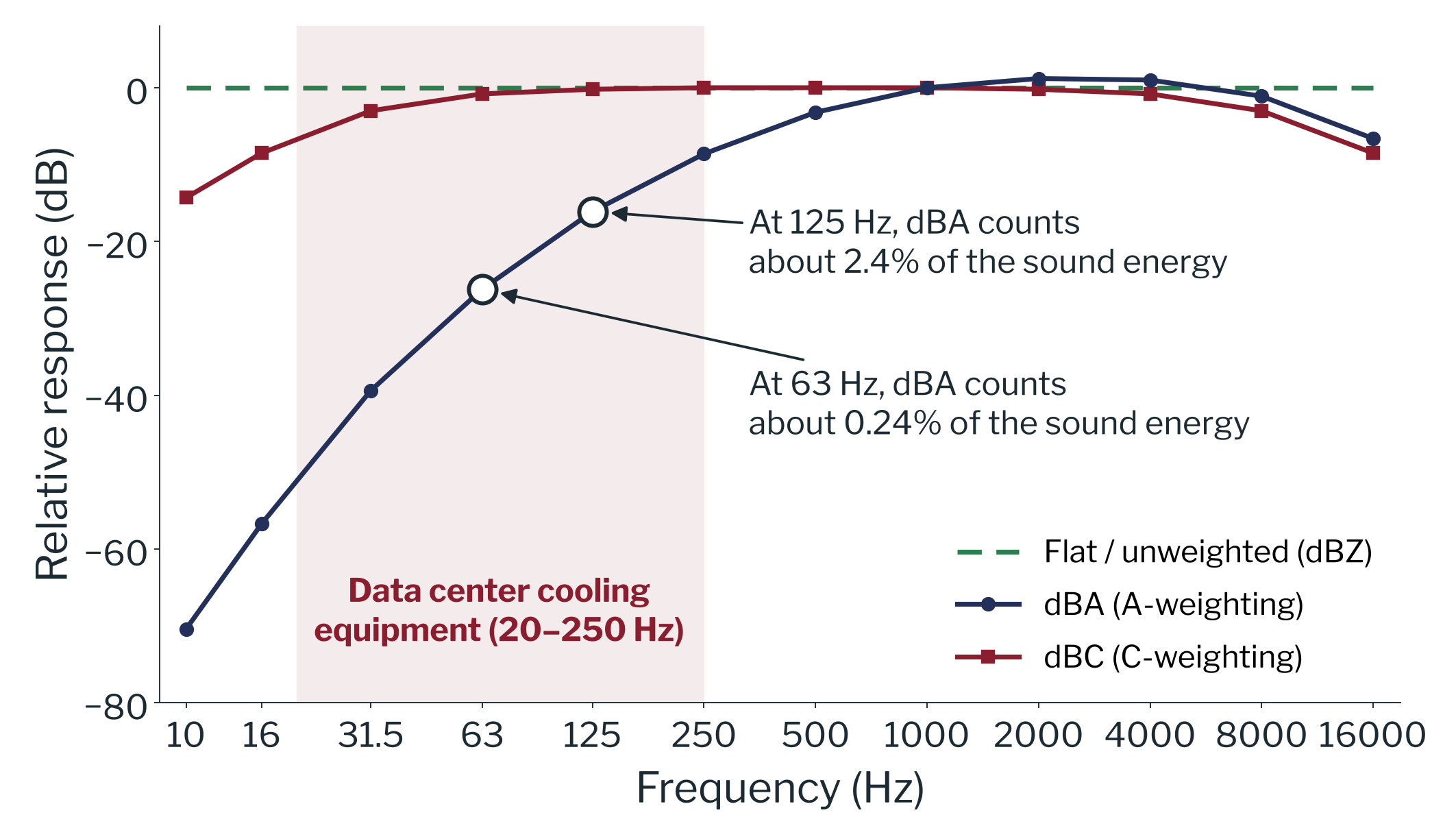
Standard A- and C-weighting curves (IEC 61672-1) [4]. The shaded band is where data center cooling equipment produces most of its sound. The World Health Organization notes that when noise has strong low-frequency components, dBA-based measures are not adequate, and recommends a frequency analysis when dBC exceeds dBA by more than 10 dB [5].
Problem 2: overall sound levels hide tonal hums
A single dBA or dBC rating can look deceptively unremarkable on a meter, yet cause significant annoyance. Low frequency hums, like those produced by data center equipment, hide inside a measure that accounts for total loudness across a large range of frequencies. The examples below illustrate how two sounds can share the exact same decibel level while feeling very different to us. Because tonal hums cut through broadband noise, many standards apply a penalty for prominent tones [5].
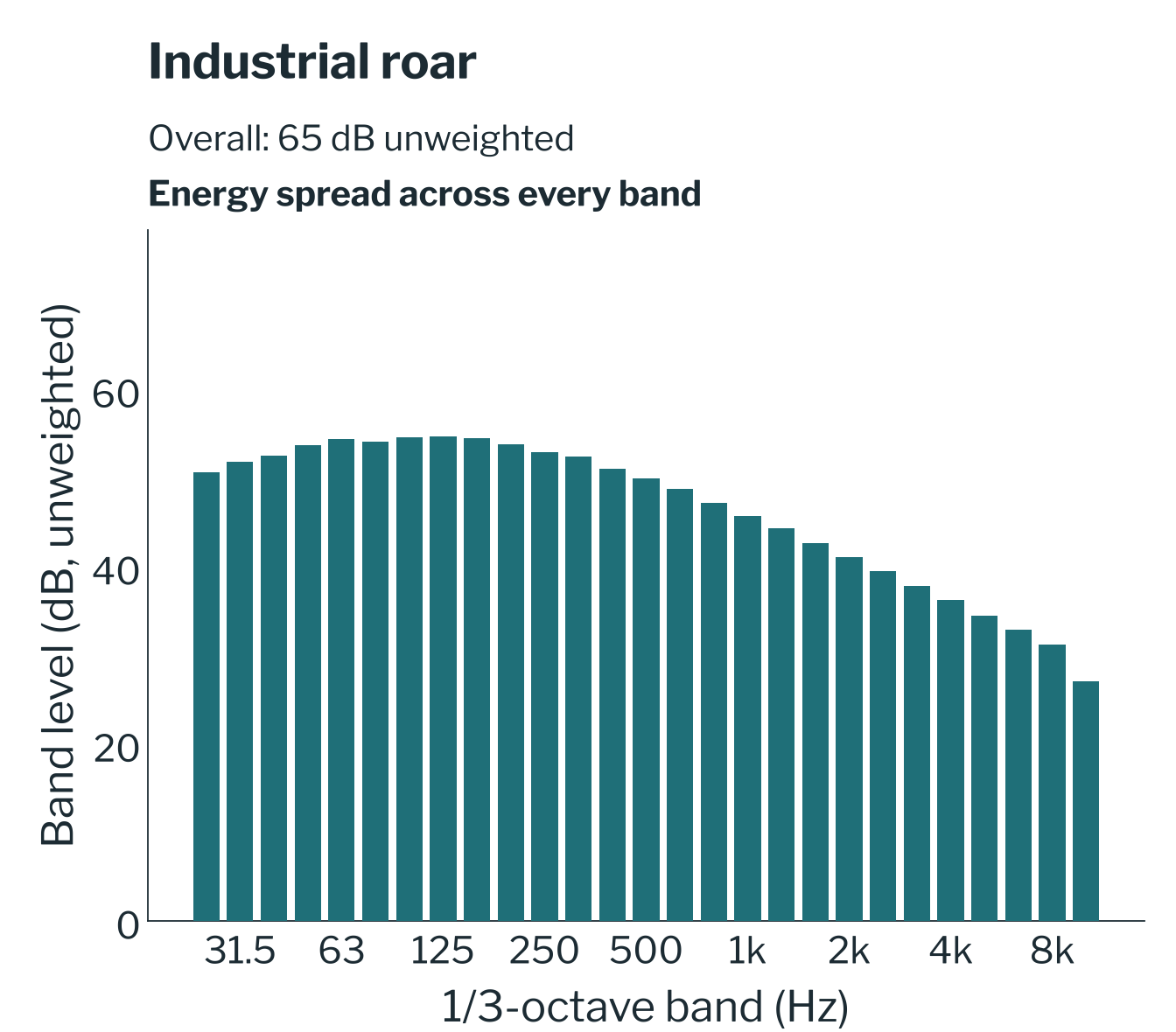
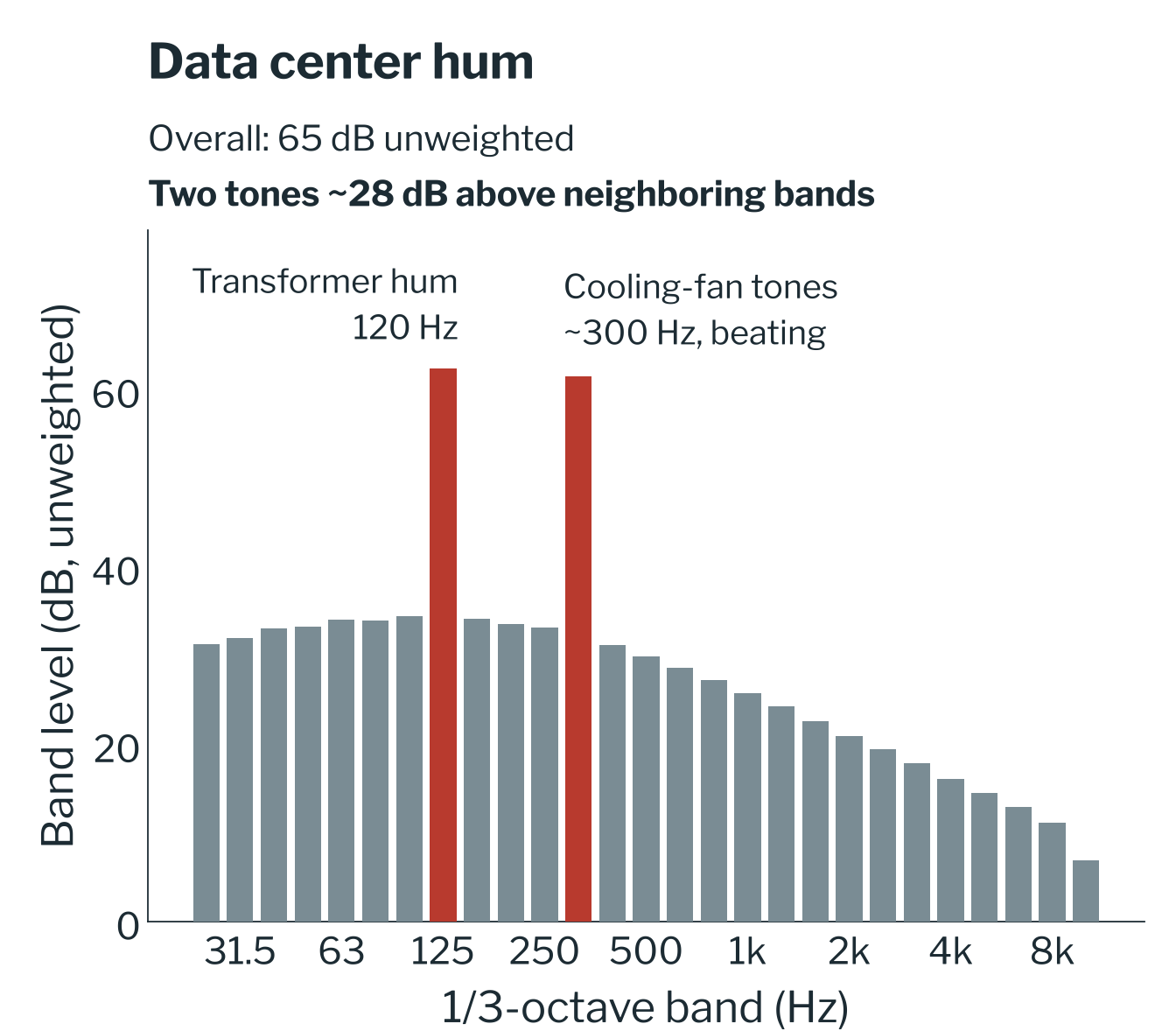
Synthesized examples matched to the same unweighted level (65 dB). Here their dBA and dBC readings also come out within about 1 dB, so a sound level meter would rate them nearly the same. Only a 1/3-octave band analysis shows the tones.
Listening tip: Play both clips at the same volume. Headphones or speakers with good bass make the difference clearer; phone speakers reproduce little below about 200 Hz.
All this translates to potentially greater impact on nearby humans
The human toll of constant noise
The continuous operational noise from data centers can inflict a heavy toll on nearby residents. Decades of medical research link chronic environmental noise to sleep disturbance, annoyance, heightened cardiovascular risk, and negative cognitive effects in children [6, 7, 8].
Why data centers are different
While past research has primarily targeted highways and airports, data center noise introduces a new type of disruptive environmental noise. Facilities run continuously through the night and emit heavy, low frequency tonal hums that standard noise barriers struggle to block.
Surging legal backlash
Community pushback against data centers is growing, with widespread protests, zoning battle, and lawsuits unfolding across multiple states. Class-action lawsuits representing groups ranging from 1,000 households to more than 10,0000 people have been filed in 2026, with many targeting the relentless low frequency hum of the cooling systems [9–12].
What can we do about it?
Cooling choices affect noise
Closed-loop (dry) cooling uses far less water but more electricity. It relies on large fan arrays that run continuously and produce low-frequency hum that travels far.
Open-loop (evaporative) cooling uses much more water and less electricity. More of its noise is at mid and high frequencies, which fade faster with distance.
Direct-to-chip liquid cooling carries heat away from the processors in liquid, then rejects it through one of the systems above. Placing pumps, heat exchangers and other equipment in enclosed, below-grade structures can reduce noise at neighboring homes.
better noise regulations
Measure in both dBA and dBC. A large gap between them flags low-frequency noise [5].
Require 1/3-octave band analysis to catch tonal hums that look unremarkable in overall dBA or dBC readings, with a penalty or limit for prominent tones [6].
Set setbacks by the noise the operating facility will produce, not a fixed distance, with larger setbacks for larger facilities.
Limit nighttime levels, since the equipment runs all night.
For more details on noise policy guidance, see my Environmental Noise page
Sources Cited
Kleyman, B. (2024, April 15). Data center rack density has doubled. And it's still not enough. Data Center Knowledge. Reports AFCOM State of the Data Center survey averages.
Supermicro. SRS-GB200-NVL72 rack-scale system specifications (total rack power 132 kW, liquid-cooled).
ISO 9613-1:1993. Acoustics — Attenuation of sound during propagation outdoors — Part 1: Calculation of the absorption of sound by the atmosphere. Values for 10 °C and 70% relative humidity, as tabulated in ISO 9613-2.
IEC 61672-1:2013. Electroacoustics — Sound level meters — Part 1: Specifications (A- and C-weighting).
ISO 1996-2:2017. Acoustics — Description, measurement and assessment of environmental noise — Part 2: Determination of sound pressure levels (assessment of tonal audibility).
World Health Organization (1999). Guidelines for Community Noise. Geneva: WHO.
World Health Organization Regional Office for Europe (2018). Environmental Noise Guidelines for the European Region. Copenhagen: WHO.
Basner, M., et al. (2014). Auditory and non-auditory effects of noise on health. The Lancet, 383, 1325–1332..
Michigan Advance (2026, May 27). Federal class-action lawsuit filed over Dowagiac data center noise.
TechRadar (2026, July 8). Wisconsin residents allege noise and light pollution at Microsoft data center.
Tech Insider (2026). NJ AI data center sued again over noise: 1,013 homes.
The Next Web (2026, June 11). Mississippi residents file a 10,000-strong class action against xAI and SpaceX over data-centre noise.